
1
× 9 on your fingers
Hold up 10 fingers and fold down the one you’re multiplying by. Fingers on the left are tens, on the right are ones: 9 × 3 = 27.
Multiplying and dividing by 9: see it, print it, practise online
Pick the tables and a mode. We’ll show mistakes on a map, so they can be practised again straight away.
Tips for parents: tricks that leave far less to learn by heart.
Hold up 10 fingers and fold down the one you’re multiplying by. Fingers on the left are tens, on the right are ones: 9 × 3 = 27.
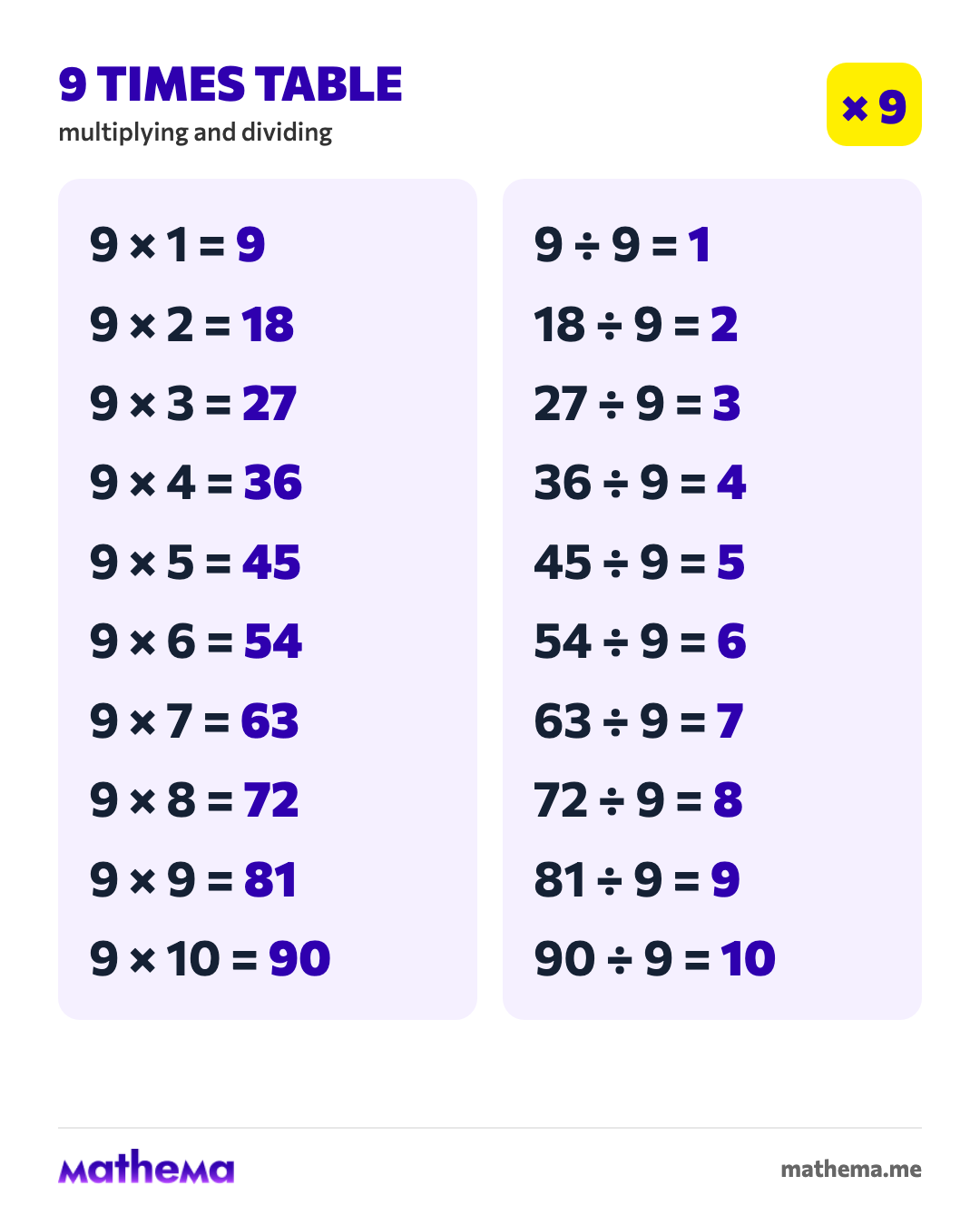
9 × 6 is 10 × 6 minus one 6: 60 − 6 = 54. The whole 9 times table works this way.
In the 9 times table the digits always add up to 9: 18 (1 + 8), 27, 36, 45 … 81. And the tens digit is one less than the number you multiply by: 9 × 6 = 54.
Use fingers: hold up both hands and fold down the finger for the number you’re multiplying by — the fingers on the left are tens, on the right are ones. 9 × 4: 3 fingers on the left, 6 on the right, so 36.
9 × 6 = 54, 9 × 7 = 63 and 9 × 8 = 72. A simple check: the digits always add up to 9 (5 + 4, 6 + 3, 7 + 2), and the tens digit is one less than the number you multiply by.
In Year 4, together with the 6 and 7 times tables. The finger trick and “one step back from 10” make it one of the quickest to learn.
Most children need a few weeks of 10–15 minutes a day. Short and regular beats an hour once a week.
Yes. A colour and a black-and-white grid, a column poster and a blank grid to fill in — all A4, free and with no sign-up.
A maths tutor for Year 4 pupils explains it so it stays: online, one to one, at your child’s pace.
